|
|
 |
Greetings From The Arrupe Coordinator |
|
|
Greetings all,
The focus of this edition of our newsletter is on nurturing the vital art and grace of authentic listening. It sounds so easy to say ‘we should listen to each other’, but in practice, it is so difficult to do. I mean, to really listen.
The early part of the newsletter contains a short, but profound reflection on listening to the Spirit by Pedro Arrupe SJ. This is followed by a reflection on listening as a giver of the Spiritual Exercises by Dr Jenny Gardner. This is then followed by some podcast suggestions, some books, and some articles, all on the theme of listening. Finally, we have suggestions for retreat experiences where the opportunity is given to listen at a deeper level to what we are being called to be, and to do with this “one precious life” we have been given.
|
|
|
|
|
|
|
Editorial
|
When hearts listen, angels sing.
- ANONYMOUS
|
We have just heard that Pope Leo has signed his first exhortation, ‘Dilexi te,’ (“I have loved you”), and is to be published on October 9. The title is a clear indication that is the sequel to Pope Francis’s last encyclical, ‘Dilexit nos” (“He loved us”). Apparently, it is all about hearing the cry of the poor in our contemporary world. Hopefully, we can listen to that cry!
The capacity to listen to each other contemplatively (and respectfully) appears to be fading rapidly from our political and cultural landscape today, so it is timely to focus on the art and grace of listening in this edition of our newsletter. Over the last few weeks, I have experienced many inputs; some have made me hopeful, and some have given me reason to be deeply concerned some of the more dangerous cultural currents that are sucking us in to their orbit. I read with concern, a brief statement recently released by The Pontifical Academy of Sciences titled “Protecting Freedom of Science and Preventing Distortion of Scientific Truth”. The fact that this group of concerned scientists feel the need to pen such a letter at this time is a reason to pay attention. It does not pull punches; it warns:
|
|
|
Patterns have emerged in recent years that indicate a disturbing trend: scientific institutions are being undermined through political
pressure, budgetary and workforce cuts, and censorship. Evidence-based findings are ignored or openly mis-represented. The peaceful, open discourse that characterizes the scientific process is being replaced in some quarters by ideology-driven narratives, misinformation, and disinformation. In extreme cases, scientists are harassed, marginalized, or personally threatened for their work.
|
This should worry all of us. Recently too, I listened to an excellent podcast on the ABCs Philosopher’s Zone; it was an interview with Matthew Sharpe, a Lecturer and Researcher in the School of Philosophy at the Australian Catholic University, and he reflected on the features of fascism as explored in the writings of the French philosopher and novelist, Albert Camus. It sounds like a very ‘academic’ interview, but in fact
it was profoundly practical, accessible, enlightening, and prescient. I felt as I listened that he was using history to read the signs of our times. It is well worth the 40-minute investment, for it is a lesson in the importance, value, and relevance of ethical research.
While there is every indication that we are entering a period of severe turbulence, there are also good reasons for hope; the primary one being the sheer number of people of good will and moral integrity that exist on our planet, people who want to build a better and more just world for all. Just two weeks ago I went to hear Cardinal Stephen Chow from Hong Kong speak of building what he called ‘a listening church’, a church that nurtured a culture of empathy and encounter – a synodal church. He spoke about his approach to working with the Chinese Communist Party, where he makes every effort to empathise with, and foster relationships of deep mutual respect. In this he sees Matteo Ricci SJ as “a great role model”, who started his ministry in China by
building authentic friendships and by listening with deep respect and acceptance to the culture he was encountering. This, in Cardinal Chow’s view, is what it means “to build bridges”. Building bridges, “is looking for convergence, not compromise”; we create common ground to create something new. It was clear that he not only believes, but also embodies, great hopes for the future of relations with the Chinese Communist Party – all founded on deep listening.
I also attended recently another deeply insightful presentation by the Spanish Jesuit Javier Melloni. He spoke about Ignatian discernment as sacred listening to integral reality. A way of listening that has three dimensions: the divine, the human, and the world (cosmic). So, we need to be present to God, present to ourselves and present to the circumstances within which we live; and only if we listen with this level of awareness can we engage in authentic discernment.
In our efforts to listen well, we can take encouragement from inspiring individuals like Dag Hammarskjöld, (the second Secretary-General of the United Nations, serving from 1953 until his death in 1961), who in his own life was able to hold these three dimensions; the divine, the human, and the world (political) in perfect balance. For him, hope was found through solidarity, particularly with those most disadvantaged and disempowered. He believed that peace begins in the “private world of each one of us” and extends outwards to our social and political spheres.
This requires a deep understanding of others, and empowers us to become agents of hope in our fractured world. This journey begins with listening. Let us hope most of us can take this option, rather than some of the more destructive ones we are being offered in the present age.
|
|
|
|
|
|
|
Pedro Arrupe SJ – His words, His Vision
|
It will be difficult, but we can do it. We can do it because, despite our historical limitations and failures, there is something which lies at the very center of the Ignatian spirit, and which enables us to renew ourselves ceaselessly and thus to adapt ourselves to new situations as they arise.
What is this something? It is the spirit of constantly seeking the will of God. It is that sensitiveness to the Spirit which enables us to recognize where, in what direction, Christ is calling us at different periods of history, and to respond to that call.
This is not to lay any prideful claim to superior insight or intelligence. It is simply our heritage from the Spiritual Exercises of Saint Ignatius. For these Exercises are essentially a method enabling us to make very concrete decisions in accordance with God’s will. It is a method that does not limit us to any particular option, but spreads out before us the whole range of practicable options in any given situation; opens up for us a sweeping vision embracing many possibilities, to the end that God himself, in all his tremendous originality, may trace out our path for us. It is this “indifference,” in the sense of lack of differentiation, this not being tied down to anything except God’s will, that gives to the Society and to the men it has been privileged
to educate what we may call their multi-faceted potential, their readiness for anything, any service that may be demanded of them by the signs of the times.
Jesuit education in the past had its limitations. It was conditioned by time and place. As a human enterprise it will always be. But it could not have been a complete failure if we were able to pass on to you this spirit of openness to new challenges, this readiness for change, this willingness—putting it in Scriptural terms—to undergo conversion. This is our hope: that we have educated you to listen to the living God; to read the Gospel so as always to find new light in it; to think with the Church, within which the Word of God always ancient, ever new, resounds with that precise note and timbre needed by each historical epoch. For this is what counts; on this is founded our confidence for the future.
From Education For Social Change
|
|
|
|
|
|
|
|
|
Do you feel a calling to become a Giver of the Spiritual Exercises of St Ignatius? If you do, consider joining us in the Arrupe Program in 2026.
|
We are accepting applications for 2026. If you feel you have a calling to become a giver of the Spiritual Exercises of St Ignatius, we would be very happy to hear from you. We welcome those who have qualifications and experience in Spiritual Direction and those who do not.
Details of our program can be viewed on our website.
I can be contacted directly at michael.loughnane@arrupe.org.au.
|
|
|
The Arrupe Program is separate from but collaborates closely with the Spiritual Direction course at ACU. Most of our candidates study at ACU as part of their formation to become givers of the Spiritual Exercises.
|
 |
Would you like to study spiritual direction at the Australian Catholic University? |
Develop knowledge, understanding and the foundational skills suited to the ethical, self-aware and safe practice of spiritual direction in the Ignatian tradition by enrolling in the Graduate Diploma in Spiritual Direction, or, the Master of Spiritual Direction.
|
 |
Being shaped by the holiness of others |
Dr Jennifer Gardner, Spiritual Director in Western Australia shares her experience of giving the full Spiritual Exercises of St Ignatius.
In a recent gathering I attended, we prayed for the grace “that we allow ourselves to be close enough to holiness that we are shaped by it.” For me, accompanying others through the full Spiritual Exercises has been an experience of being ‘shaped’ by the holiness of others.
Initially I found it a daunting task. As part of the Arrupe Program I was required to accompany two people through the full Spiritual Exercises. Where would I find them, how would I go, could I sustain this process? By the grace of God, two beautiful women with generous hearts in one of our Christian Life Community groups offered to make this journey with me. Covid and the restrictions this placed on our lives, actually made it more doable. Since then, I have accompanied five others and have recently begun the journey again.
How have I been ‘shaped’ by this experience? I have felt overwhelmed with gratitude for the opportunity to see and hear God at work so intimately, in another’s life. At times, in observing the struggles and the joys of others, I have recognised my own feelings of inadequacy. I find that I constantly learn from others and have been inspired and encouraged by them. My understanding and compassion have deepened.
I now take more time to consider and take on a retreatant. The ‘retreat in daily life’ journey is a long one, sometimes up to 18 months. Life intervenes along the way (my life or theirs) and we need to take breaks. Picking up the threads again takes patience and sensitivity. I find I have a tendency to tire mid-journey and then revive as we move into the fourth week to experience the joy so evident in the retreatant. Then I need a break!
It is perhaps the integration of the retreatant’s ordinary life events – the deaths of parents, struggles with children or employment, illness and unexpected events that I find most challenging and where the Spirit is often most evident. I am learning to step back and allow God to deal directly with the person (as Ignatius encourages us to do). I am learning to ask more specifically for the graces that I need.
I find great consolation in seeing someone grow in their faith and through healing, to a deeper acceptance of themselves and an openness to be led by God in their lives. It is a great privilege to walk alongside a person for a period of time and to share their joys and struggles. Lastly, it is hidden work, not to be shared in any detail with others and so I am grateful for this opportunity to write about it in a small way. I found this quote from Fr Kevin O’Brien SJ captured the experience for me:
In the Exercises, directors too meet the living God. We thus begin the adventure with great gratitude, humility and expectation. (The Ignatian Adventure; 2011, p.30)
|
|
|
|
|
|
|
How to become a good listener and why that’s important
Big Ideas, Radio National
Are you a good listener? Unfortunately, not many of us can answer that with a convinced ‘yes’. And that’s even though listening is at the core of every relationship. Losing the ability to listen has profound social, psychological, and neuroscientific impacts.
But the good news is: You can learn how to do it – quite easily in fact.
You're Not Listening presented at the Brisbane Writers Festival. May 7, 2021.
Original broadcast on June 28, 2021.
Speakers
Kate Murphy - Journalist and New York Times contributor
Chair: Michaela Kalowski - interviewer and facilitator
|
|
|
Living Myth: Violence, Despair and Young Men
While often being considered the leading nation in the world, the United States increasingly finds itself on the cutting edge of cultural upheaval, political polarization and increasing violence that includes mass shootings and politically motivated killings. The recent tragedy of a political activist being shot and killed by a radicalized young man, while appearing distinct in the sense of being a political assassination, can also be seen as part of the larger tragedy of young men acting out cultural violence.
Whether we like it or not, young people tend to manifest, express and even act out the psychological and emotional symptoms of the culture in which they must grow. In particular, if young men are not fully invited into social life and given a genuine sense
of meaning and purpose, something volatile and potentially destructive inside them can drift towards the darker areas of the psyche and in the modern world, can pull them into the darkest parts of the world wide web.
|
|
|
The Philosopher’s Zone: Who’s responsible for Extreme Beliefs?
It's easy to say that people who hold extreme antisocial beliefs should be held responsible for those beliefs. But in fact, many extremists operate within what philosophers call impoverished epistemic environments - epistemic "bubbles" and echo chambers whose inhabitants might be ignorant of the truth, or subject to manipulation. But does that mean responsibility for extreme beliefs therefore lies with the wider public? And if so, what are we to do about it?
|
|
|
|
|
|
|
Summer Kitchen by Donald Hall
|
In June’s high light she stood at the sink
With a glass of wine,
And listened for the bobolink,
And crushed garlic in late sunshine.
I watched her cooking, from my chair.
She pressed her lips
Together, reached for kitchenware,
And tasted sauce from her fingertips.
“It’s ready now. Come on,” she said.
“You light the candle.”
We ate, and talked, and went to bed,
And slept. It was a miracle.
- “Summer Kitchen” by Donald Hall from The Selected Poems of Donald Hall. © Houghton Mifflin Harcourt, 2015.
|
I love the slowness in this poem; the quiet, the silence – so normal, natural and homely. It is a Martha and Mary scene in a sense (Luke 10:38-42), with husband and wife taking traditional roles (the woman does the work, while the man sits and contemplates!). But whatever the gender role ambiguity, there is a beauty in the scene, a real attentiveness and sense of awe, gratitude, and appreciation. The poet is a witness to something, and that ‘something’ is the sheer wonder and beauty of ordinary moments, when we live with intentionality and attentiveness in communion with others (in this case an intimate partnership). It epitomises the sacred quality
of deep attentiveness – which is deep listening.
|
|
|
|
|
|
|
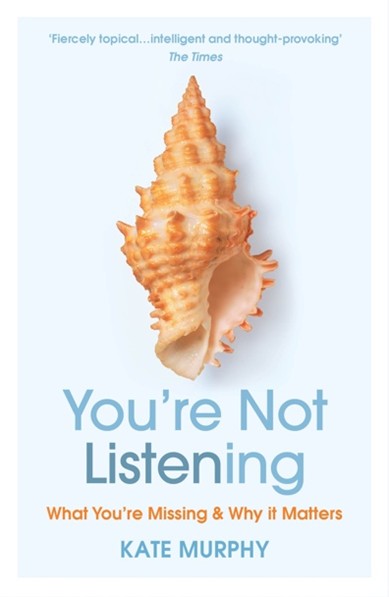
You’re Not Listening
By Kate Murphy
“In modern life, we are encouraged to listen to our heats, listen to our inner voices, and listen to our guts, but rarely are we encouraged to listen carefully and with intent to other people. Instead, we are engaged in a dialogue of the deaf, often talking over one another at cocktail parties, work meetings, and even family dinners; groomed as we are to lead the conversation rather than follow it. Online and in person, it’s all about defining yourself, shaping the narrative, and staying on message. Value is placed on what you project, what you absorb. … And yet, listening is arguably more valuable than speaking. …”
|
|
|
Holy Listening
By Margaret Guenther
A down-to-earth book, full of practical wisdom and sound advice. The whole communicative thrust of the book centres on the idea that spiritual direction is about “holy listening,”, presence and attentiveness, not domination and submission. A ‘must read’ I would say for every spiritual director.
|
|
|
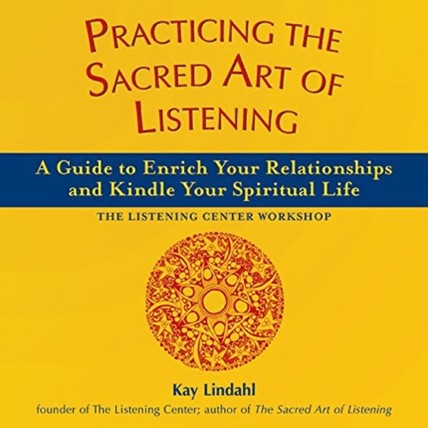
Practicing the Sacred Art of Listening
By Kay Lindahl
“There are many wonderful tools and techniques for more effective listening, such as active listening, empathic listening, relational listening, and body language. The premise of my work is that listening is more than technique. When two people are deeply listening to one another, we sense that not only are they present to each other, but they also are present to something beyond their individual selves – some call it spiritual holy, or sacred. Musicians refer to it as aesthetic rapture, mystics describe it as ecstasy, athletes call it being in the zone, and jazz artists say they are in the groove. All of them speak about it as a moment when time stands still. They are simply being in the experience. It is the same with listening.”
|
|
|
|
|
|
|
Obstacles to Good Listening
By Robin Daniels
“Listening is challenging and potentially life-enhancing, not only for the speaker but also for the listener. Listening inspires work that is never-ending: constant self-listening, willing and brave self-learning, resulting in continuous self-healing. The speaker will sense, and may grow stronger from knowing, that the learning in and from these encounters can be a two-way process. The healing elements of listening include not only what happens in the speaker—catharsis, the unblocking and easing of repressed memories, and insight, integration, more sense of identity and self-esteem—but also the degree of relatedness the two people attain, often while or after walking together along awkward paths, sometimes bumpy, sometimes steep.”
|
|
|
Listening to the Land for Spiritual Direction By Greg Kennedy
“And listen we must. Not so much because our lives depend on it, but, more meaningfully, because our love depends on it. Another reason that spiritual directors discover such richness in their work, is due to the expansion of love involved. I challenge you to dislike anyone
who sincerely, humbly lets you in on their vulnerability and most treasured longings. The spontaneous response to such a privilege is gratitude and love …”
|
|
|
The listening gift
By Faith Lawrence
“Listening is the dark matter of conversation, a mysterious activity that shapes the cosmos of any society or relationship. A friend who is a good listener can turn an ordinary conversation into a life-changing one, though we’re more likely to recall what they said (the evidence of their listening) than the listening itself. We shout, we sing, we whisper, we rhyme, but describing our listening is difficult, and its lexicon less obvious. What if we thought of ourselves as ‘listening’ animals, equipped and adapted to receive language, rather than as animals that talk? Would we talk about listening more precisely? Would we want to?
The philosopher Ludwig Wittgenstein argued that the limits of our language are the limits of our world …”
|
|
|
|
|
|
|
 |
Ignatian Silent Retreats - Plan for 2026 |
Come away to a quiet place and rest awhile. Mark 6.30
Our JISA Spiritual Directors warmly welcome you to come and rest, contemplate, pray, and discern, in our Ignatian Silent Directed Retreats.
Explore our 2026 Silent Ignatian Retreats
|
|
|
 |
What is God asking of me? Discernment Retreat Days – Kew VIC |
Join us as we explore ways of discerning the loving voice of God speaking to us at the core of our being. These two retreat days will include praying with scripture, imaginative contemplation, sacred conversation, and other spiritual exercises taught to us by St Ignatius.
Two retreat days
Saturday 1st November and Sunday 2nd November 20259am – 4pm each day
|
| EXPLORE
|
|
|
 |
Come and Rest Retreat Day – Kew VIC |
Immerse yourself in rest, silence, reflection on Scripture, art, poetry, and sharing of prayer experiences. Summer, the Season of Fruitfulness is on our doorstep, and we warmly welcome you to come and rest in the beautiful grounds of Campion House in Kew.
Saturday 29th November, 9.30am – 3pm
|
| EXPLORE
|
|
|
 |
IM25 Ignatian Earthing TWO – Online in November |
See with new eyes, pray with your whole body, and let God in nature speak to your soul. Experience and learn four Ignatian prayer forms – in the four ecologies of Mountains, Desert, Ocean, and City.
Whether you are seeking a deeper spiritual life, a connection to the Earth, or simply space to pause and listen, IM25 offers a path – grounded in Ignatian prayer and animated by our living world. In a time when both the soul and the Earth cry out for healing.
Join us every Tuesday in November 2025
November 4th, 11th, 18th, and 25th
Online at 6.30-8.30 pm AEDT
$90 for all four sessions
$25 for a single session
|
| EXPLORE
|
|
|
|
|
|
|
|
“I have the impression that my life is written in a single sentence: ‘It has unfolded according to the will of God’.”
- Pedro Arrupe
|
|
|
|
|
|
|