|
|
|
|
 |
|
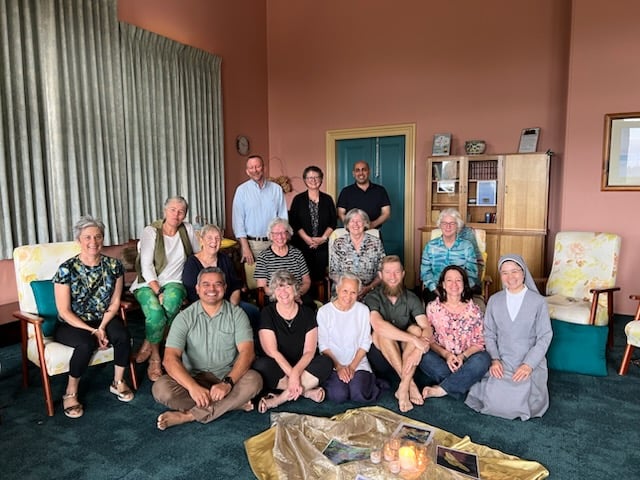
New Arrupe Candidates for 2026 with facilitators at Santa Casa in Queenscliff in late February |
|
|
Greetings From The Arrupe Coordinator |
|
Hello all,
Our Arrupe formation program got off the ground with an intimate retreat in Santa Casa, (in Queenscliff), for all new candidates in the program in 2026. We began by reflecting deeply on “My Experience of the Spiritual Exercises”, which amounts to a ‘re-savouring’ of the graces of the Spiritual Exercises over a four-day period. We enjoyed lovely weather for the experience, good food, convivial conversation, and an ideal location. This was a wonderful start to the Arrupe experience, as it offered the opportunity not only to revisit the graces, but to share and bond together as a group. We all know, we learn just as much from listening deeply to each other, as we do from formal study. Now the year is well underway, and having just completed an overview of the Four Weeks of the Exercises with the entire cohort, we are exploring a variety of aspects of the Spiritual Exercises week on week. We have much to look forward to, with many guest speakers from Australia and overseas to come. We also have our 8-day retreat at Sevenhill in July, which is already fully subscribed.
Many may wonder why I would dedicate another newsletter to Artificial Intelligence and its impact on spiritual direction (the first was in 2024). Well, the reason is simple: the rate of change in the intervening two years has been rapid and consequential. Now, the real impact of AI is beginning to be felt in every area of human endeavour, as well as in our personal lives. So, this newsletter is somewhat of an ‘update’ on the previous one. I hope you will find something that will pique your interest from the many resources on offer.
By the way - just in case you haven’t already discovered it - I would like to let you know about a podcast that might be of interest to you. It is The Spiritual Life with James Martin SJ. He started this podcast in June of last year and has now clocked up over 30 episodes. Why not sample a few? Here is a selection of my highlights: His very first interview last year was with Cardinal Timothy Radcliffe; then another early interview with Cardinal Stephen Chow, on being Christian in a Chinese culture; then Br. Buy Consolmagno on praying as a scientist; another very important one for spiritual directors was with Patrick Gilger SJ, on Why you need a spiritual director; then this year, an interview with Sister Norma Pimentel MJ, who ministers to migrants on the US-Mexico border; a lovely interview too with Anne Lamott on her “Help, Thanks, Wow” spirituality; and finally two outstanding podcasts on being gay and Catholic, one with Fr Bryan Massingale, and another with Gregory Maguire. There is much wisdom to be imbibed from these wells of experience and insight. |
|
|
|
|
|
|
Quo vadis, humanitas? |
(Where are we as humanity going?) |
|
“We are two decades into the era of social media and smartphones, and we're lonelier than ever. So we want to know, is tech displacing or even replacing the humans in our lives?”
(From All In The Mind: Brain Rot: Will AI turn us off human relationships?) |
|
In recent years, artificial intelligence systems have increasingly taken control of the production of texts, music and videos. This puts much of the human creative industry at risk of being dismantled and replaced with the label “Powered by AI,” turning people into passive consumers of unthought thoughts and anonymous products without ownership or love. Meanwhile, the masterpieces of human genius in the fields of music, art and literature are being reduced to mere training grounds for machines.
(Message of Pope Leo XIV for the 60th world Day of Social Communications 2026) |
|
“In this moment of the 21st century, the human family finds itself facing questions so radical that they even threaten its existence as we have known it up to now,” the document says, adding that human beings today are exposed to risks “never imagined before.”
(Quo Vadis Humanitas?) |
|
In January 2024 Pope Francis devoted his World Day of Social Communications message to the subject of Artificial Intelligence. This year, Pope Leo has devoted his first World Day of Social Communications address to the same subject. Now, just this month, the International Theological Commission, has published a lengthy reflection on AI and Social Media (Quo Vadis Humanitas?). This analysis offers a very balanced and measured approach to the challenge of AI. |
|
|
|
The commission cautions that forms of knowledge and calculation detached from embodied, situated human intelligence — and from relational knowledge passed down through generations via education — can become a threat to the true good of humanity.
But the horse may have already bolted in this regard. What follows is a lengthy quote from the former Google CEO and chairman Eric Schmidt in a recent interview. It offers a brief but sobering glimpse into the future that is opening up before us:
|
|
“We believe as an industry, that within one year, the vast majority of programmers will be replaced by AI programmers. We also believe that within one year that they will replace graduate level mathematicians that are at the tippy-top of graduate math programmes; that's one year, okay. What happens in two years? Well, I've just told you about reasoning and I've told you about programming and I’ve told you about math; programming plus math are the basis of our whole digital world, so the evidence and the claims from the research groups in Open AI and Anthropic and so forth is that there now somewhere around 10% or 20% of the code that they are developing in their research programmes is being generated by the computer; that's called recursive self-improvement (it’s the technical term). So, what happens when this thing starts to scale? Well, a lot; one way to say this is that within the three to five years will have what is called general intelligence (AGI), which can be defined as a system that is as smart as the smartest mathematician, physicist, artist, writer, thinker, politician … In the next year or two this foundation is being locked in, and it's not we're not going to stop it. It gets much more interesting after that, because remember the computers are now doing self-improvement; they're learning how to plan and they don't have to listen to us anymore. We call that super intelligence (ASI – Artificial Super Intelligence), and this is the theory that there will be computers that are smarter than the sum of humans the San Francisco Consensus is that this occurs within six years, just based on scaling. Now in order to pull this off, you have to have an enormous amount of power. This path is not understood in our society, there's no language for what happens with the arrival of this. This is happening faster than our society, our democracy, our laws can address … that's why it's under-hyped; people do not understand what happens when you have intelligence at this level, which is largely free. …” |
|
This is not reassuring. But it’s evident from what he says that a shift of enormous proportions is coming our way - one that has the potential to sideswipe us, not only collectively, but individually as well. It is quite difficult to take in. But we Christians have the rich resources of our tradition to sustain us. We do not succumb to the mystique of AI, but rely for our identity and our sustenance on the mystery of the Incarnation: God becoming our very identity. No manufactured machine, no matter how intelligent or ‘human-like’ can ever be granted this level of importance or sacredness.
I leave the last word to Pope Leo, who, (quoting Gregory of Nyssa), reinforces the uniqueness and sacredness of every single human being: |
|
“The fact of being created in the image of God means that, from the moment of his creation, man has been imprinted with a regal character [...]. God is love and the fount of love: the Fashioner of our nature has made this to be our feature too, so that through love — a reflection of divine love — human beings may recognize and manifest the dignity of their nature and their likeness to their Creator”
(Saint Gregory of Nyssa, On the Making of Man, quoted in Pope Leo’s recent message on the 60th World Day of Social Communications) |
|
|
|
|
|
|
Pedro Arrupe SJ – His words, His Vision |
|
Excerpts from: “A Beacon of Hope in a World of Despair”. (1977)
This powerful message from Pedro Arrupe SJ is so prescient it could have been written this week... |
|
Today man experiences, at the individual and at the social level, a deep emptiness, a spiritual void that neither technological progress nor materialistic ideologies can fill up. Disillusioned in his search for something that transcending him might give him meaning and freedom, man turns to himself only to discover his utter inability to attain alone and unaided his final destiny. Torn between, on the one hand, a rationalism and a technology that often manipulate and dehumanize him, and, on the other, an hedonism which, instead of fulfilling him, only accentuates his inner solitude and dissatisfaction, man looks for support and understanding among his fellowmen. But this emerging hope soon vanishes, when he finds men deeply divided, envious and mistrustful of one another, and when he discovers that the community—which was to be his main source of security and support—threatens to absorb him and deprive him even of his personal freedom and identity.
[…]
In a matter of such vital importance and urgency for the future of mankind, we Christians should take the lead. We should .show to a world that considers itself “post-Christian,” that Christian love and solidarity are still very much alive and operative in human society, even if we know that our example and witness will not always be recognized or appreciated. Thus we will prove, in a very effective way, that Christianity, far from being “the opium of the people’,” is a living force that can tackle the present situation, with courage and realism, and point out to contemporary man the path towards a solution which man, left to his own a-transcendental resources, would never be able to discover nor to find effectively a reason for utilizing here below.
[…]
To rely on power and might, to seek always personal prestige, is basically to place one’s hope in oneself. Though He also could justifiably have done so, this second temptation was rejected outright by Christ with the words: “You shall not tempt the Lord your God.” For man however, the temptation remains a particularly seductive one. The unprecedented progress of modern science and technology, as well as many other branches of knowledge, seems an open invitation to deny contingency and proclaim a self-sufficient autonomy in which transcendent values have no place or meaning. The perfect society seems not only within reach but attainable by human efforts alone.
In recent years, however, this confidence has diminished somewhat in the light of the spectacular failure of so many plans and projects, and of the hard evidence that several major world problems are becoming more acute rather than less. Some are beginning to acknowledge not only “the ambiguous nature of progress,” but also the fact that it “deepens rather than solves the mystery of the heart of man; nor does it provide the complete and definitive answer to the desire which springs from his innermost being.”
The true Christian hope that we expect from the Church today neither loses confidence in face of the futility of things nor places that confidence in itself. In the words of the liturgical prayer, it proclaims clearly: “Our help is in the name of the Lord.” There is a well-known saying of St. Ignatius, one version of which reads as follows: “So trust in God as if the issue depended entirely on Him and not at all on you; but put in a total effort as if it was to be all your doing and not God’s at all.”
[…]
The Christian, faced with the world and its problems, far from being a pessimist, is essentially an optimist; far from shunning human responsibility and effort he is the first to commit himself to the task of building a world more just and more human and never gives up in despair. In pursuing his temporal task the Christian, for the love of God and of his fellow-men works, struggles and, if need be, dies, “in hope against all hope,” knowing that while his work, struggle and life are necessary conditions for the World’s transformation and man’s liberation, that transformation and liberation will be ultimately and fully achieved only through God’s Grace: “By the grace of God I am what I am.”
This is the hope we and the Church have to offer the world of today. But first we must possess it ourselves. This requires, on our part, a deep faith and an intimate union with Christ. |
|
|
|
|
|
|
|
|
Do you feel a calling to become a Giver of the Spiritual Exercises of St Ignatius? If you do, consider joining us in the Arrupe Program in 2027. |
|
We are accepting applications for 2027. If you feel you have a calling to become a giver of the Spiritual Exercises of St Ignatius, we would be very happy to hear from you. We welcome those who have qualifications and experience in Spiritual Direction and those who do not.
Details of our program can be viewed on our website.
I can be contacted directly at michael.loughnane@arrupe.org.au. |
|
|
|
The Arrupe Program is separate from but collaborates closely with the Spiritual Direction course at ACU. Most of our candidates study at ACU as part of their formation to become givers of the Spiritual Exercises. |
 |
Would you like to study spiritual direction at the Australian Catholic University? |
|
Develop knowledge, understanding and the foundational skills suited to the ethical, self-aware and safe practice of spiritual direction in the Ignatian tradition by enrolling in the Graduate Diploma in Spiritual Direction, or, the Master of Spiritual Direction. |
|
|
|
|
|
|
|
Is AI making our brains lazier?
(All in the Mind on Radio National)
Social media gave us brain rot; will AI give us cognitive atrophy? How can we possibly learn to cope with the sheer amount of uncertainty and change heading our way? |
|
|
|
The AI Con – Unpacking the artificial intelligence hype machine with Emily M Bender
(Big Ideas on Radio National)
Is the world really in the midst of an AI revolution, or is it all just clever marketing, powered by immense amounts of money, capital and hype? This episode arms you to spot AI hype in all its guises, expose the exploitation and power-grabs it aims to hide, and push back against it at work and daily life. |
|
|
|
Ultra-Processed Information: AI and the Coming Deluge of Noise
(The Great Simplification)
Nate Hagens explores the growing sense that many people feel disoriented and overwhelmed in a world increasingly saturated with digital content. Constant exposure to headlines, hot takes, summaries, and algorithm-driven feeds can erode our sense of clarity rather than strengthen it. The rapid rise of artificial intelligence has served to dramatically increase the speed of information production while also eroding accuracy, making it difficult to differentiate between content that simply sounds confident and content that's actually grounded in reality. |
|
|
|
If Anyone Builds It, Everyone Dies: How Artificial Superintelligence Might Wipe Out Our entire Species
(The Great Simplification)
Were ASI to come to fruition, it would be so powerful that it would outcompete human beings in everything – from scientific discovery to strategic warfare. What might happen to our species if we reach this point of singularity, and how can we steer away from the worst outcomes?
In this episode, Nate Hagens is joined by Nate Soares, an AI safety researcher and co-author of the book If Anyone Builds It, Everyone Dies: Why Superhuman AI Would Kill Us All. Together, they discuss many aspects of AI and ASI, including the dangerous unpredictability of continued ASI development, the "alignment problem," and the newest safety studies uncovering increasingly deceptive AI behavior. Soares also explores the need for global cooperation and oversight in AI development and the importance of public awareness and political action in addressing these existential risks. |
|
|
|
Can Humanism Survive the Age of AI? The Reith Lectures by Rutger Bregman’s 2025 Reith Lectures.
The Dutch historian Rutger Bregman, is calling for a moral revolution to change our societies for the better, charting how small groups of committed people – abolitionists, suffragettes, and temperance activists – have brought about positive social change.
Politics, Bregman argues, is in trouble in an age of apathy and backsliding democracy: “The moral rot runs deep across elite institutions of every stripe”, he says, “if the right is defined by its shameless corruption, then liberals answer with a paralyzing cowardice”.
So where might our moral salvation come? What are the deep values that underpin our contrasting political worldviews – left and right – and which should we look to prioritise now? Does any part of the political spectrum have the greatest claim to morality?
These are really illuminating and thought-provoking lectures. Well worth the time and effort. If you don’t want to invest this amount of time into engaging with Rutger Bregman, then you can get the ‘summary’ version here on Late Night Live. |
|
|
|
|
|
|
The End and the Beginning
By Wisława Szymborska |
|
After every war
someone has to tidy up.
Things won't pick
themselves up, after all.
Someone has to shove
the rubble to the roadsides
so the carts loaded with corpses
can get by.
Someone has to trudge
through sludge and ashes,
through the sofa springs,
the shards of glass,
the bloody rags.
Someone has to lug the post
to prop the wall,
someone has to glaze the window,
set the door in its frame.
No sound bites, no photo opportunities,
and it takes years.
All the cameras have gone
to other wars.
The bridges need to be rebuilt,
the railroad stations, too.
Shirtsleeves will be rolled
to shreds.
Someone, broom in hand,
still remembers how it was.
Someone else listens, nodding
his unshattered head.
But others are bound to be bustling nearby
who'll find all that
a little boring.
From time to time someone still must
dig up a rusted argument
from underneath a bush
and haul it off to the dump.
Those who knew
what this was all about
must make way for those
who know little.
And less than that.
And at last nothing less than nothing.
Someone has to lie there
in the grass that covers up
the causes and effects
with a cornstalk in his teeth,
gawking at clouds.
(Translated by Stanislaw Baranczak and Clare Cavanagh) |
|
What I love about Wisława Szymborska’s poetry is her courage and commitment not to resile from naming the world as it is. Yet, her work is never pessimistic; virtually every one of her poems is imbued with a deep hope for humanity. Szymborska won the Nobel prize for literature in 1996, and in my view, she richly deserved it. She received the award "for poetry that with ironic precision allows the historical and biological context to come to light in fragments of human reality". This poem exemplifies those traits. In these times it is a reminder of the catastrophic impact war has on ordinary people. But the passing of time dulls the memory and Szymborska leaves us with the image of someone who has no real memory or connection with the pain and trauma that exact place has been through in the past, “stretched out/blade of grass in his mouth/gazing at the clouds”. I am reminded of the wisdom of Flannery O’Connor on the connection between enlightenment and the passing of time: “It does not take much to make us realise what fools we are, but the little it takes is a long time coming.” |
|
|
|
|
|
|
|
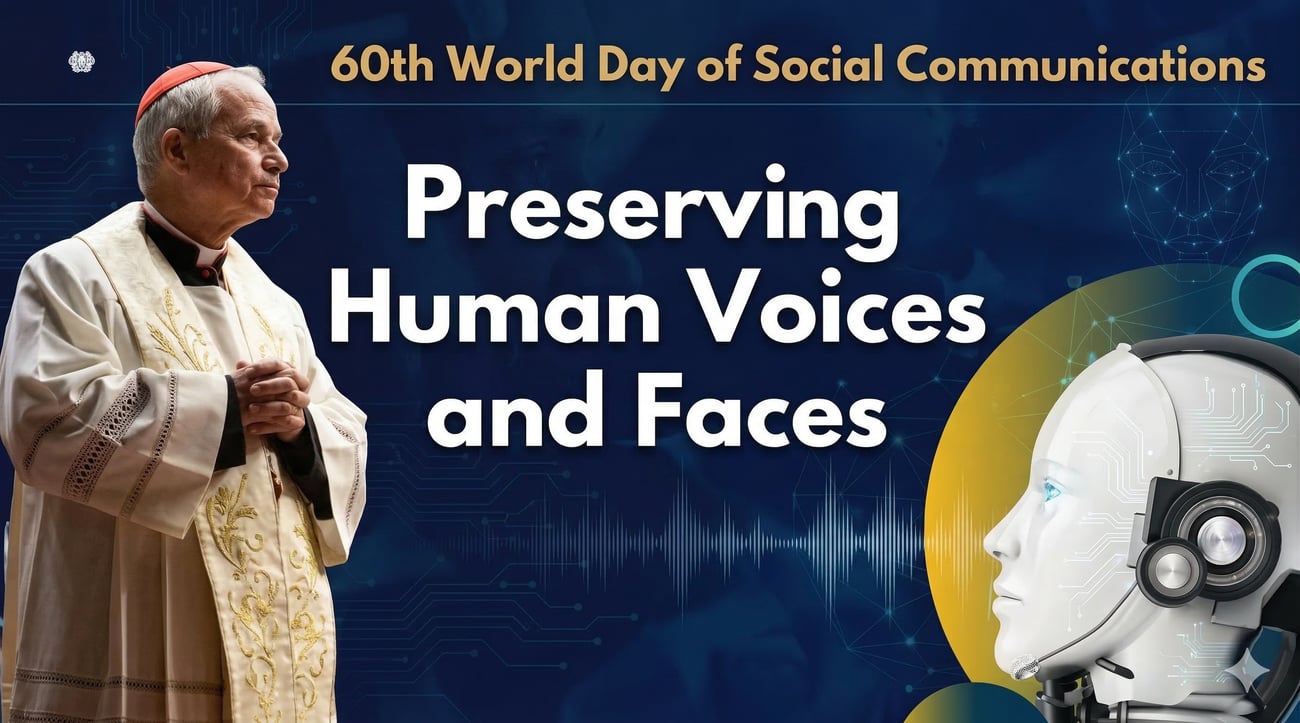
Preserving Human Voices and Faces
Message of His Holiness Pope Leo XIV for the 60th World Day of Social communications (Jan 2026)
“… digital technology threatens to alter radically some of the fundamental pillars of human civilization that at times are taken for granted. By simulating human voices and faces, wisdom and knowledge, consciousness and responsibility, empathy and friendship, the systems known as artificial intelligence not only interfere with information ecosystems, but also encroach upon the deepest level of communication, that of human relationships.
The challenge, therefore, is not technological, but anthropological. Safeguarding faces and voices ultimately means safeguarding ourselves. Embracing the opportunities offered by digital technology and artificial intelligence with courage, determination and discernment does not mean turning a blind eye to critical issues, complexities and risks. …” |
|
|
|
Political Economy and Artificial Intelligence: Innovation and Uncertainty
William McCormick SJ, (February 9, 2026)
While the expectations for an artificial intelligence (AI) revolution remain high in some quarters, many of its concrete consequences must remain speculative until the revolution materializes. How dramatically will AI change the world? Will AI introduce new patterns of political, social and economic power, or will it reinforce previous ones? How will political authorities, whether national or international organizations, manage and govern those changes, if at all?
No one knows the answers to these questions, and human society finds itself at a moment of acute uncertainty. Regardless of the actual consequences of AI, however, the very prospect of such transformations underlines a fundamentally anthropological question: “Will [AI] be programmed to assist, support and enhance humans, or to replace them?” … |
|
|
|
ARTIFICIAL INTELLIGENCE A Theological Approach
By Calum Samuelson
A thoughtful reflection on the intersection between theology and AI.
An excerpt:
“As AI becomes increasingly common, it is important to remember that love always prioritises the other. AI may help people feel happier, be more efficient, obtain more knowledge and even feel more ethical, but if it does not improve human relationships, it is ultimately misdirected. Accordingly, people should be very cautious about seeking to outsource or automate the most common and apparently mundane manners in which they give themselves in love to others. The simple gift of listening is rapidly being replaced by AI. The command to weep with those weep (Romans 12:15) is being threatened Love always prioritises the other by AI tools that detect our mood and tell us how to fix it. …”
|
|
|
|
|
|
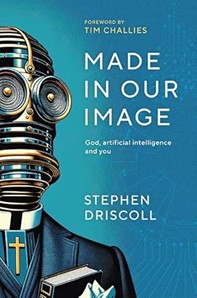
Made in Our Image
by Stephen Driscoll
Artificial intelligence is here. And this tech revolution, perhaps more than any such revolution that’s gone before, is changing the world. How do Christians navigate their way through these momentous changes? What does Christianity have to say about this brave new world? What will living a life of faith look like in a world where humans, made in God’s image, coexist with intelligent machines made in our image? Author, pastor and self-confessed ‘tech realist’ Stephen Driscoll sets out to answer those questions with a deep dive into the intersection of faith and technology. Avoiding the extremes of both the tech worshippers and the ‘doomers’, Driscoll offers accessible and illuminating insights into the nature of AI, along with practical tips on how Christians might use this technology for good. |
|
|
|
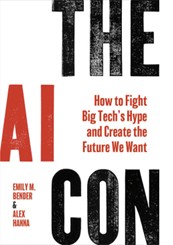
The AI Con: How To Fight Big Tech's Hype and Create the Future We Want
by Emily M. Bender
Two of the world's best-known AI insiders-turned-critics expose the lies and hype surrounding AI
A smart, incisive take-down of the bogus claims being made about so-called 'artificial intelligence', exposing the real harm these technologies do to our jobs, health, society and environment, who stands to gain from them, and how to fight back.
Is AI going to take over the world? Have scientists created an artificial lifeform that can think on its own? Is it going to replace all our jobs, even creative ones, like doctors, teachers and care-workers? Are we about to enter an age where computers are better than humans at everything?
The answers to these questions, as the expert authors of The AI Con make clear, are 'no', 'they wish', 'LOL', and 'definitely not'. In fact, these fears are all symptoms of the hype being used by tech corporations to justify data theft, motivate surveillance capitalism, and devalue human creativity so they can replace meaningful work with jobs that treat people like machines. Meanwhile, across healthcare, education, media, government and law-enforcement, 'AI' products are already being introduced that are unreliable, ineffective, unjust and dangerous.
Packed with real-world examples, pithy arguments and expert insights, The AI Con arms you to spot AI hype in all its guises, expose the exploitation and power-grabs it aims to hide, and push back against it at work and in your daily life. |
|
|
|
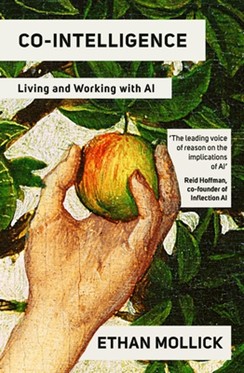
Co-Intelligence: Living and Working with AI
by Ethan Mollic
Here is a useful guide to working, learning, and living in the new age of artificial intelligence. Consumer AI has arrived, and with it, inescapable upheaval as we grapple with what it means for our jobs, lives and the future of humanity.
Cutting through the noise of AI evangelists and AI doom-mongers, Wharton professor Ethan Mollick has become one of the most prominent and provocative explainers of AI, focusing on the practical aspects of how these new tools for thought can transform our world. In Co-Intelligence, he urges us to engage with AI as co-worker, co-teacher and coach. |
|
|
|
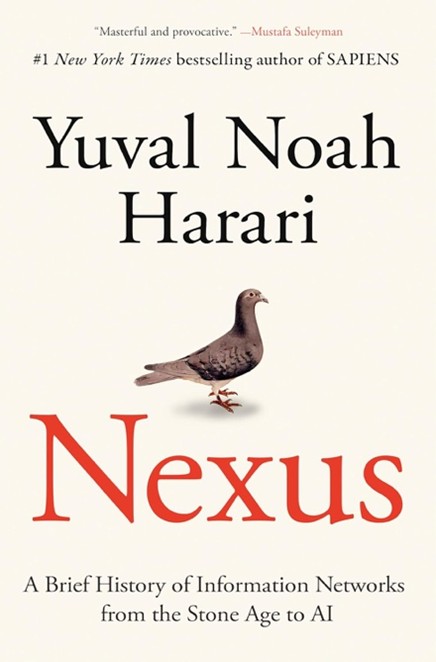
Nexus: A Brief History of Information Networks from the Stone Age to AI
by Yuval Noah Harari
From the author of Sapiens comes the groundbreaking story of how information networks have made, and unmade, our world.
For the last 100,000 years, we Sapiens have accumulated enormous power. But despite all our discoveries, inventions, and conquests, we now find ourselves in an existential crisis. The world is on the verge of ecological collapse. Misinformation abounds. And we are rushing headlong into the age of AI--a new information network that threatens to annihilate us. For all that we have accomplished, why are we so self-destructive?
Nexus looks through the long lens of human history to consider how the flow of information has shaped us, and our world. Taking us from the Stone Age, through the canonization of the Bible, early modern witch-hunts, Stalinism, Nazism, and the resurgence of populism today, Yuval Noah Harari asks us to consider the complex relationship between information and truth, bureaucracy and mythology, wisdom and power. He explores how different societies and political systems throughout history have wielded information to achieve their goals, for good and ill. And he addresses the urgent choices we face as non-human intelligence threatens our very existence.
|
|
|
|
|
|
|
 |
Ignatian Silent Retreats |
|
Individual guided residential retreats from 2 to 8 days, at beautiful locations nationally. Our silent retreats offer time away from the daily noise with a quiet still space to rest, reflect, and listen deeply to God’s presence within. Whether you are new to or familiar with Ignatian spirituality, you are welcome.
|
| EXPLORE |
|
|
 |
Australian Ignatian Trail |
|
This ‘camino’ experience provides an opportunity for encountering Ignatian Spirituality, discerning, and listening to God’s presence in Nature. Step aside from everyday life, walk, reflect, experience nature day after day, time in silence, conversation and listening to God’s presence. And walk in the footsteps of the first Jesuits in Australia.
2026 Dates: 4 walking days – 6 nights in OCTOBER. |
| EXPLORE |
|
|
 |
An Ignatian Journey from Contemplation to Action |
|
A four-week online retreat during May 2026 to mark Laudato Si Week. Join us for a journey from contemplation to action, with Ignatian prayer and discernment practices to enlighten how we can care for our common home. |
| EXPLORE |
|
|
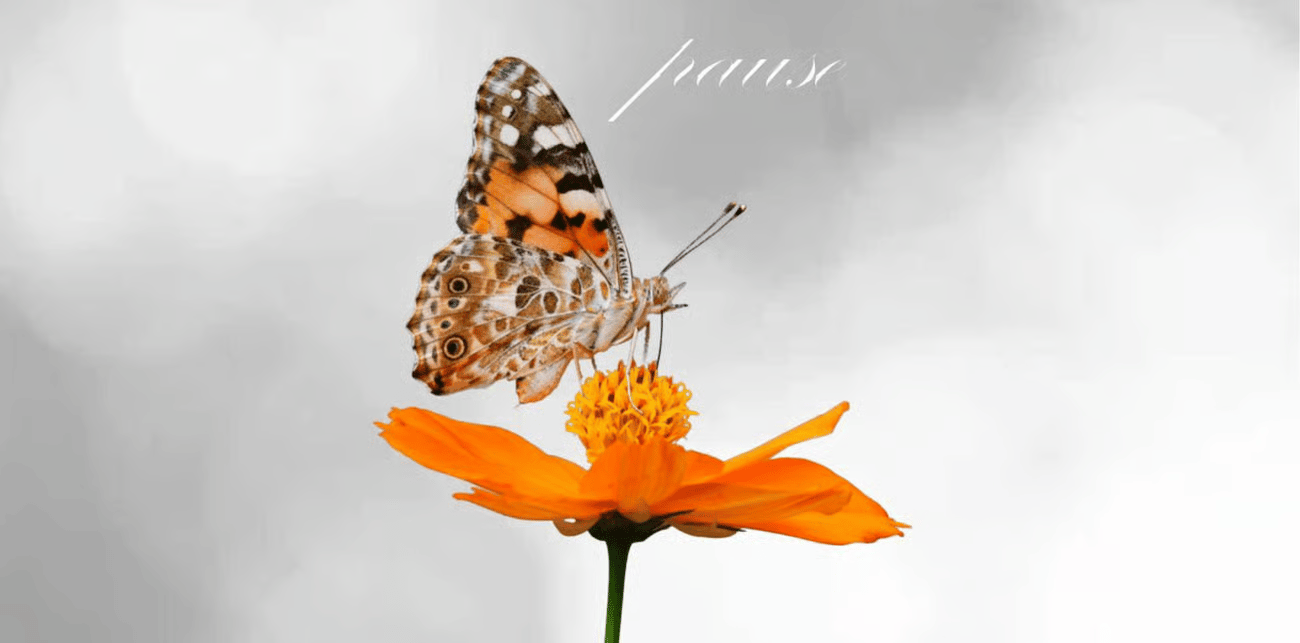 |
Pause, A Retreat for Women |
|
A small group retreat for women who seek a time of prayer, guidance, and stillness amidst the natural transitions of life to come and rest, and discover the emerging call of transformation and flourishing that God is inviting you to, God’s love, wisdom and wish for you.
This popular retreat is being offered again in 2026 at
Sevenhill SA in May
Brisbane in July
Melbourne in October
Sydney in October |
|
|
|
|
|
|
|
|
|
|
|
“Today man experiences, at the individual and at the social level, a deep emptiness, a spiritual void that neither technological progress nor materialistic ideologies can fill up”
- Pedro Arrupe |
|
|
|
|
|
|